|
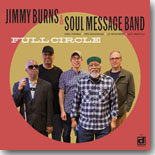 Jimmy Burns recorded a number of 45s
between the mid '60s and mid '70s that have
become collector's items. His latest Delmark
release, backed by the Soul Message Band,
features remakes of five songs he recorded over
the years, plus several tunes that he considered
favorites. Jimmy Burns recorded a number of 45s
between the mid '60s and mid '70s that have
become collector's items. His latest Delmark
release, backed by the Soul Message Band,
features remakes of five songs he recorded over
the years, plus several tunes that he considered
favorites.
Full Circle
is a bit different from Burns' other Delmark
releases in that, thanks to the efforts of the
Soul Message Band (Chris Foreman – B3, Greg
Rockingham – drums, Geof Bradfield – sax, Lee
Rothenberg – guitar, Chris Jung – alto sax) and
guests Typhanie Monique (vocals) and Steve Eisen
(baritone/tenor saxes), the tracks have a
definite soul and jazz feel that fits to a tee.
The opening
track, Charles Wright's (like Burns, a
Clarksdale, Mississippi native) “Express
Yourself,” gets the album off to a delightfully
funky start as the band locks into the groove
from the jump and never lets up. Big Joe
Turner's “World Of Trouble” gets a wonderful
late night jazz treatment, with Foreman's B3
featured prominently throughout, and “I Really
Love You,” recorded initially by Burns in 1972,
is taken at a slightly more relaxed pace,
leaning more toward blues than soul, than the
original.
The Soul Message
Band takes center stage on the terrific
soul/jazz instrumental, “Ain't That Funk For
You,” with each member enjoying a moment in the
spotlight. Burns' originally recorded Lowman
Pauling's “Too Much Lovin'” on his 1999 Delmark
release, Night Time Again, and this
version has a more soulful, jazzy feel with the
band's approach.Monique adds playful backing
vocals.
Burns also
previously recorded “Give Her To Me,” in 1965
for Tip Top Records, with this version running
fairly close to the original, other than the B3
replacing the piano on the Tip Top version.
Burns wrote “It Used To Be,” also for Tip Top,
and recorded it in 1966. The newer version works
better with B3 replacing the Farfisa organ of
the original, and this version leans more to the
blues and jazz side of the aisle.
The Soul Message
Band turns in another great instrumental with
the late '40s jazz/pop standard, “Since I Fell
For You,” before Burns closes the set with one
of his favorites, a steady rolling read of Lil'
Son Jackson's “Rock Me Mama,” and a soulful
“Where Does That Leave Me,” which he originally
recorded for Dipso Records in the early '70s.
Burns reminisces
about all of these songs in the extensive liner
notes, showing an uncanny memory for dates and
personnel on his original recordings and even
the songs he covers. Rockingham adds remarks on
the Soul Message Band's two tracks as well.
Full Circle
is an outstanding release that will be
satisfying to blues and jazz fans, and will
probably send them out to track down Jimmy
Burns' original recordings of these songs, as
well as more music from the Soul Message Band.
--- Graham Clarke
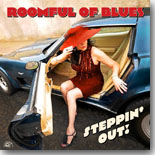 Has
it really been more than 50 years when Rhode
Island-based Roomful Of Blues hit the
worldwide blues scene? Has
it really been more than 50 years when Rhode
Island-based Roomful Of Blues hit the
worldwide blues scene?
It's
true, with 50 years being a low estimate. Formed
in 1967, this band is pushing 60 since they
played their first notes together. I'm certainly
glad its rotating members have kept their big
band / jump blues sound as vital and refreshing
as ever.
Guitarist Chris Vachon has been the man in
charge for over three decades, and longtime sax
player Rich Lataille has been blowing his horn
since 1970. What's new with this album is the
band's first ever female vocalist, and D.D.
Bastos fits right in with the boys.
The
new album, Steppin' Out! (Alligator
Records), contains 14 cuts of high energy,
raucous jump blues, a blend of well-chosen
covers. I used to call albums like this a "party
in a jewel case," which is no longer quite
accurate, so I'll think of some other clever
phrase reflecting how music is distributed a
quarter of the way through this century.
Bastos shows right away that she's capable of
being the front woman of this group with
powerful vocals on the up-tempo Billy Emerson
stomper, "Satisfied." Mike Coffey's primal
drumming helps kick off the song, with each
pounding of the skins a call to action for the
rest of the band.
We
get a taste of the deep south, still staying
with a rapid beat, on Z.Z Hill's "You Were
Wrong," before Vachon treats us to exquisite
guitar playing on the slow, snaky Jimmy
McCracklin song, "Steppin' Up In Class." Bastos
sings with plenty of sass as she announces to
that man that she's moving onward and upward.
Nice sax solo from Lataille, too.
The
Little Richard standard tune "Slippin' And
Slidin'" returns the session to a fast moving
tempo, with both Vachon and piano dude Jeff
Ceasrine treating us to very nice solos. Bastos
sings about her tortured love on a slow blues,
"Please Don't Leave," as she now wants that man
to stay with her. We've all heard multiple
versions of "Tell Me Who," but it was Big
Maybelle who put it on the map, and Bastos is
perfectly capable of delivering her own
memorable rendition.
She
then summons her inner Big Mama Thornton on
another classic, "You Don't Move Me No More,"
with Vachon and Lataille adding their sound to
this mid-tempo keeper. I hesitate to keep
refrering to the originals of these songs as
'classic,' but that's what they were and still
are, including "Good Rockin' Daddy," done years
ago by Etta James. Christopher Pratt joins in
with a very tasteful trumpet break.
David Bartholomew's slow-paced ballad, "Tend To
Your Business," has Bastos, Vachon, and Lataille
each contributing a certain element of sadness.
That mournful mood doesn't last long on the
fast-paced Tiny Bradshaw number, "Well Oh Well,"
with Lataille blowing away on his tenor sax.
Bastos ends the song with some very nice scat
singing.
Bastos does more girlish vocals, similar to the
female voice on "Why Don't Cha Stop It," the
1956 Mercury original done by Buddy and Ella
Johnson, It's a mid-tempo blues shuffle
that gives multiple horn players the chance to
solo. We get another Big Maybelle cover on the
wild ride known as "I've Got A Feelin'," with
the conga drumming mimicking the Okeh original.
I love this song. I'll call it the best of the
album, but my mind could change depending on my
mood.
"Dirty People" is a mid-tempo blues piano
shuffle done originally by Smiley Lewis, with
Cesrine playing steady tinkling piano before
Vachon turns in a strong guitar solo.
It's
too bad that the closing number lists 'writer
and publisher unknown," because someone should
get credit for this wonderful boogie woogie,
"Boogie's The Thing." Lataille and Cesrine both
shine on this stomper. A quick internet search
turns up a 1950 Mercury single by George Miller
and his Mid-Driffs, and it looks like New
Orleans prolific songwriter Dave Bartholomew
may have composed it. Regardless of who
wrote it, the song is a killer and a great
ending to still another delightful Roomful Of
Blues album.
I'm
so glad that Roomful Of Blues continues to put
out great music, and hopefully will continue to
do so for another 50 or so years.
Meanwhile, be sure to check out Steppin' Out!
It's a keeper.
--- Bill Mitchell
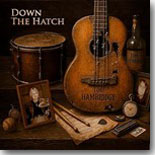 Tom Hambridge
took a break from producing for such luminaries
as Buddy Guy, George Thorogood, Christone
“Kingfish” Ingram and Keb' Mo' to release his
second album for Quarto Valley Records. Down
The Hatch features a dozen originals written
by Hambridge or co-written with Richard Fleming,
Gary Nicholson, or Thorogood. Tom Hambridge
took a break from producing for such luminaries
as Buddy Guy, George Thorogood, Christone
“Kingfish” Ingram and Keb' Mo' to release his
second album for Quarto Valley Records. Down
The Hatch features a dozen originals written
by Hambridge or co-written with Richard Fleming,
Gary Nicholson, or Thorogood.
Musical support
is provided by guitarists Guy, Bob Britt, Tom
Bukovac, and Rob McNelley, bassists Glenn Worf,
Tommy MacDonald, and Anton Nesbitt, keyboardists
Kevin McKendree, John Lancaster, Mike Rojas, and
Noah Forbes, with Tim Lauer on accordion, with
Hambridge, of course, handling the drums,
percussion, and vocals.
Thorogood
originally recorded “Willie Dixon's Gone,” which
opens this disc, and Hambridge's rip-snorting
version gets this set off to a rollicking start.
“Every Time I Sing The Blues,” originally
recorded by Eric Clapton and Guy, is a slow
burner and could well serve as a mission
statement for Hambridge's approach to his craft.
“I Want You Bad”
is a cleverly written shuffle with a gritty
vocal from Hambridge and stinging lead guitar
from McNelley. “How Blues Is That,” another
track originally recorded by Guy, is a fierce,
mid-tempo track.
On the somber
“Hard Times” Hambridge reflects on the state of
affairs, but manages to find solace with his
significant other. “What Does That Tell You” is
a catchy blues rocker with crisp guitar work
from Britt. “Believe These Blues,” originally
recorded by Kingfish, is a slow blues that looks
at what causes the blues and why they will
always be with us, while the amusing “Making
Lemonade” is a real rocker about standing tall
in the face of adversity.
The soulful “What
Might Have Been” has a bit of a country feel,
thanks to Britt's guitar, as Hambridge ponders
the effects of a broken romance. “You Gotta Go
Through St. Louis” is a rollicking instrumental,
written in tribute to Chuck Berry, featuring Guy
on guitar and McKendree on piano.
“Start Drinking
Early Day” is a jaunty country blues, and “I
Wanna Know About You,” the album closer, has a
light, countrified feel via Britt's guitar work
and Hambridge's amiable vocal.
Tom Hambridge
never fails to impress with his own recordings,
or his productions for other artists for that
matter. Down The Hatch is loaded with
great songs and performances that deftly mix
blues, rock, and roots in equal measures. This
is a fine album that will satisfy fans of all
three genres.
--- Graham Clarke
 BB & The
Bullets (Brian Baker – guitar/vocals, Brad
McMillan – drums/vocals, Stu Duncan –
bass/vocals) are a Whanganui, New Zealand-based
blues rock band. Their debut effort as a group,
High Tide (Dixie Frog Records), offers
seven original tunes from Baker, plus five
impressive covers of blues and soul classics
that seamlessly blend the band's rock, soul, and
blues roots. BB & The
Bullets (Brian Baker – guitar/vocals, Brad
McMillan – drums/vocals, Stu Duncan –
bass/vocals) are a Whanganui, New Zealand-based
blues rock band. Their debut effort as a group,
High Tide (Dixie Frog Records), offers
seven original tunes from Baker, plus five
impressive covers of blues and soul classics
that seamlessly blend the band's rock, soul, and
blues roots.
The opening
track, the Baker original “Something In The
Water,” is a mid-tempo rocker with a catchy
pop-like refrain and some sharp guitar. The
blues standard “Born Under A Bad Sign” is the
first cover, retaining the moody feel of the
Albert King version with a bit more of a rock
edge in its delivery.
The title track
is next, a blues-flavored ballad that adds Eddie
Raymer on organ, and “I Can Tell,” an old Bo
Diddley number, has a funky undertone that works
well. Baker's “Seven Ways To Sin” has a classic
southern rock groove and is a fun, retro track,
as is Rufus Thomas' “Walking The Dog,” an upbeat
tune that probably works great on the band's
live shows.
“Little Fishes”
is an interesting track, sort of a swampy rocker
with a pop feel, but the band's cover of The
Beatles' “I Want You (She's So Heavy)” is pretty
faithful to John Lennon's bluesy original
version, with Baker expanding on the guitar solo
with great results.
“Letting Go” is a
slow burning ballad with some nice instrumental
work and a heartfelt vocal from Baker, and the
final cover is “The Thrill Is Gone,” associated,
of course, with B.B. King. The band really turns
in a strong, soulful reading of this familiar
tune, Baker's guitar work is crisp and concise
and McMillan and Duncan's rhythm work is superb.
The pace picks up
considerably with “Brian's Boogie (Hurry Home),”
a tasty instrumental showcasing Baker's guitar,
and the closer, “Big Boot Running,” mixes rock
and funk effectively.
High Tide
is a well-rounded set of blues, rock, and soul.
BB & The Bullets combine impressive original
songs with well-crafted covers of blues classics
and excellent musicianship. They're a band that
deserves to be heard beyond their native
country.
--- Graham Clarke
 Musical artists
from Mississippi have received more Grammy
awards and nominations than any other state in
the country, and the city of Jackson,
Mississippi has the nation's highest
concentration of Grammy Award winners per
capita. Jackson is known as The City With Soul
and the local music scene has always been an
active and vital scene, focusing on blues,
gospel, rock, and pop in recent years. Musical artists
from Mississippi have received more Grammy
awards and nominations than any other state in
the country, and the city of Jackson,
Mississippi has the nation's highest
concentration of Grammy Award winners per
capita. Jackson is known as The City With Soul
and the local music scene has always been an
active and vital scene, focusing on blues,
gospel, rock, and pop in recent years.
Recently, Kamal
King and Joe Lee authored Jacktown USA
(Republic Books), which touches on the state's
rich musical history and profiles nine current
and prominent Mississippi blues and soul
artists.
King, whose
father Lee King has been a mover and shaker on
the Jackson music scene for over a half century,
and Lee, a Jackson native who has a background
in radio, television, and journalism, initially
delve into the musical history of Jackson and
the influences that the city's music has had on
the rest of the state. They then move on to
profiles of blues artists Eddie Cotton, Zac
Harmon, Stevie J. Blues, Dexter Allen, Chad
Wesley, and Ra'Shad “The Blues Kid” McGill,
along with soul/R&B quartet Jacktown Sons, the
sibling acapella group Four Washington, and
79-year-old veteran composer/arranger Benjamin
Wright.
Most of the blues
artists profiled have had at least one release
reviewed at Blues Bytes over the years, so
readers will be familiar with some of their
work, but the profiles of each reveal new
information about influences both musically and
personally and their connection with the capital
city. The profiles are real page-turners, and
will hopefully allow these artists even more
recognition than they previously had.
There's also a
section focusing on the current Jackson music
scene and the state's five Grammy Legacy
Celebration events held in the 2010s. This was a
very quick and enlightening read for me and
should be essential reading for any fan of
blues, southern soul, and R&B.
Additionally,
there's a companion CD that is sold separately,
including eight songs from the featured book
subjects. The Jacktown Sons open with “Hold Up,”
a lively R&B piece with a lot of soul, then
Allen follows up with the clever, downhome blues
“Hooked.” Next, Cotton delivers the
autobiographical blues, “Delivered By The
Blues,” and the Four Washington siblings
contributes the lovely “Dancing In Our Love.”
Stevie J. Blues
lets the good times roll with his funky
soul-blues romp, “Juke Joint Lover,” and Harmon
offers the gritty, soulful “I Still Got The
Blues.” Wesley's tough blues rocker, “Slow
Down,” is top notch, and Ra'Shad The Blues Kid
closes this excellent Jacktown USA – The
Capital City of American Music sampler with
“Girl You Got It Going On,” a superb example of
his Pine Belt hybrid of blues and soul.
Blues fans
shouldn't be without either the book Jacktown
USA or the accompanying album. Both shed
much-needed insight on a seldom-discussed part
of the past and present blues and soul music
scenes, bringing attention to some of the state
and the genre's finest current musical talents.
--- Graham Clarke
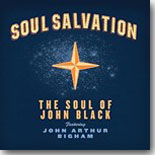 The Soul of
John Black (a.k.a. John “JB” Bigham)
recently issued Soul Salvation (Yellow
Dog Records), a powerful set that brings the
classic sounds of southern soul and blues to the
21st century. Bigham wrote all ten of the
tracks, played all the instruments except drums
(played by Oliver Charles), and produced the
set, which was recorded in Los Angeles but
sounds very much like a product crafted in
Memphis or Muscle Shoals. The Soul of
John Black (a.k.a. John “JB” Bigham)
recently issued Soul Salvation (Yellow
Dog Records), a powerful set that brings the
classic sounds of southern soul and blues to the
21st century. Bigham wrote all ten of the
tracks, played all the instruments except drums
(played by Oliver Charles), and produced the
set, which was recorded in Los Angeles but
sounds very much like a product crafted in
Memphis or Muscle Shoals.
Bigham had Albert
King in mind on the opening track, “Begging You
Baby,” with its easy, funky blues rhythm and
guitar work reminiscent of the blues legend.
It's traditional blues, contemporary style.
“Georgia Peaches”
is sweet southern soul that seeps right into
your pores as you listen when Bigham describes a
girl he met on his first trip down south. The
smooth “Take Your Time” has a real Stax Records
feel, as does the smoldering “Come and Get It,”
a canny mix of blues and soul.
“Been Gone Too
Long” is pure blues, with Bigham's spot-on
fretwork and a positively hypnotic bea. A song
easy to get lost in. The funky “That Thang”
picks up the tempo to a party pace with a
definite New Orleans vibe to get bodies on the
dance floor.
The mid-tempo
“Right Now” nicely maintains the funky blues
groove, leading into the soulful ballad “Get
Closer,” a great track to hear with a
significant other. If that track doesn't do the
trick, then “The First Time” certainly will.
The album wraps
with more soul, via the supple slow burner
“Saving It All For You.”
Bigham was born
in Chicago, but his parents were from Georgia
and Tennessee, so this music has been a part of
his life since he was born.
Soul Salvation
is the most personal release in The Soul of John
Black's catalog, with each track reflecting
Bigham's deep ties to southern blues and soul.
It's the best release in an already-impressive
body of work, appealing to blues and soul
lovers.
--- Graham Clarke
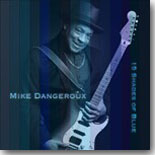 On the heels of
his spring EP release Empty Chair,
Chicago guitarist Mike Dangeroux has just
released a full-length album, 15 Shades of
Blue (RD Records), featuring 15 new original
songs. On the heels of
his spring EP release Empty Chair,
Chicago guitarist Mike Dangeroux has just
released a full-length album, 15 Shades of
Blue (RD Records), featuring 15 new original
songs.
Dangeroux, who's
performed with Koko Taylor, Mississippi Heat,
J.W. Williams, Buddy Guy, and Nellie “Tiger”
Travis, plays guitar and bass on these tracks
and is backed by Vince Vargo
(keys/strings/horns), Daron Casper Walker
(drums), and Eddie Mason (percussion). As with
the EP, Dangeroux and Vargo co-produced this
album.
“Blues Deep In My
Soul” opens the disc, first with a short
instrumental intro, than as a mid-tempo urban
blues with Dangeroux's strong vocal and sharp
guitar work. “Palm Of My Hand” is a slow burner
with more crisp fretwork, and the funky “Walking
Out That Door” picks up the pace.
“Ghosts Of The
Past” is a moody blues ballad showcasing
Dangeroux's guitar work and Vargo on keys. The
brisk “Heart Of Stone” is more upbeat, adding
horns, but the somber lyrics belie the musical
backdrop.
“Never Be Lonely”
is a soulful ballad with acoustic guitar and
organ accompaniment as Dangeroux paints a vivid
picture with his lyrics and heartfelt vocal.
“Day And Night Lover” is a vibrant piece of
R&B-fueled blues, and “No More Bad News” is a
funky, mid-tempo blues.
“Tides Of Your
Love” is another strong ballad that leans more
toward R&B than blues, and the lively “She Can't
Stop Rocking” is a radio-ready track that will
please blues, soul, or R&B fans.
Blues rockers
will dig “Where Are My Friends Tonight,” thanks
to Dangeroux's rock-edged fretwork. The disc
wraps with a pair of ballads, “Doing To Me,” and
the sultry “(Hope) You Feel The Same.”
Dangeroux proves
to be a pretty compelling songwriter, a first
rate guitarist and a strong singer. The tunes
touch on blues, soul, and R&B in equal measures,
improving on his earlier EP release.
Mike Dangeroux is
a real talent that deserves more attention and,
hopefully, 15 Shades of Blues will serve
him well.
--- Graham Clarke
 Dave Weld &
The Imperial Flames have released three
powerhouse albums on Delmark Records,with the
label now issuing an LP/digital compilation of
the band's finest moments from those albums. Dave Weld &
The Imperial Flames have released three
powerhouse albums on Delmark Records,with the
label now issuing an LP/digital compilation of
the band's finest moments from those albums.
Bluesin'
Through the Years captures nine of Weld and
the band's finest moments from 2010's Burnin'
Love, 2015's Slip Into A Dream, and
2022's Nightwalk, featuring a guest star
list that includes Lil' Ed (Weld's former boss),
Bobby Rush, Sax Gordon, Abb Locke, Tom Hambridge
and many others.
Two tracks come
from Weld's first Delmark release, Burnin'
Love, and they bookend Side B. Leading off
Side B is the mid-tempo “Ramblin'” features Lil'
Ed on rhythm guitar, Locke on tenor sax, Jeff
Taylor on drums, and Dave Keye on bass, and the
energetic rocking blues, “She's Lyin',” with
Locke, Keye, Harry Yaseen on piano, and Herman
Applewhite on bass wraps things up. Monica Myhre
and Applewhite also contribute backing vocals.
Four songs are
highlights from Weld's second release, Slip
Into A Dream. Myhre takes the mic for the
spirited “Lookin' For A Man,” and her feisty
vocals are combined with Weld's slide guitar and
Bobby Rush's harmonica. Weld and Myhre share
vocals on “May Be Right,” May Be Wrong,” a
driving rocker with a incendiary guitar solo,
and Myhre (Weld's musical and life partner) rips
through the raucous “Louise,” with reckless
abandon.
“Slip Into A
Dream” has a definite Magic Sam feel with
another shared vocal between Weld and Myhre.
Other contributors on these sides include Keye,
Taylor, Yaseen, Sax Gordon, Graham Guest
(organ), and E.G. McDaniel (bass).
The band's most
recent release, Nightwalk, offers three
sides, the first three tunes on the album, with
Weld and Myhre joined by Taylor, Yaseen, Keye,
Guest, Kenny Pickens (bass), and Tom Hambridge
(drums), who also produced. The tremendous
opening track, “Don't Ever Change Your Ways,”
serves as a thank-you note to his mentor, the
Slideslinger J.B. Hutto (also Lil' Ed's uncle).
Myhre tears up the gritty “Don't Tell Mama,” and
Weld sings and slides on the saucy “Red Hot
Tabasco.”
Bluesin'
Through the Years showcases the very best of
Dave Weld & the Imperial Flames' Delmark tenure,
and will provide a great introduction for
newcomers to the slide master's music while also
serving as a great collection for the
already-initiated.
--- Graham Clarke
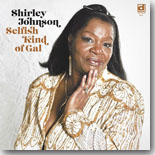 Shirley
Johnson got her start singing gospel in a
church choir at age six in her native Franklin,
Virginia, but fell in love with the blues and
R&B, especially Ruth Brown, Koko Taylor, Bobby
“Blue” Bland, B.B. King, Little Milton, Z.Z.
Hill, and Etta James. Shirley
Johnson got her start singing gospel in a
church choir at age six in her native Franklin,
Virginia, but fell in love with the blues and
R&B, especially Ruth Brown, Koko Taylor, Bobby
“Blue” Bland, B.B. King, Little Milton, Z.Z.
Hill, and Etta James.
She eventually
pursued a musical career in Virginia, opening
for various acts passing through town and
recorded some singles, which attracted attention
from a man planning to start a record label in
Chicago. She traveled to the Windy City, and
when that deal fell through she became active on
the Chicago blues scene.
Johnson
eventually was able to record two albums with
Delmark Records, 2002's Killer Diller and
2009's Blues Attack. Both were
well-received at the time, and the label
recently collected the choice tracks from both
discs for Selfish Kind of Gal, a
compilation released on LP/digital format
featuring 10 songs of prime blues and soul
handpicked by Ms. Johnson, who receives first
rate musical support from a host of Delmark's
finest supporting musicians.
Of the ten
tracks, eight are from Blues Attack, and
they are the first four songs on each side. The
confident “I'm Going To Fine Me A Lover” opens
Side A, a horn-driven, energetic tune, one of
several written or co-written by Maurice John
Vaughn.
The feisty title
track was co-written by Johnson and Vaughn,with
the singer proclaiming that she's “breakin'
hearts and havin' fun.” That duo also penned
“You Should Have Been There,” a tough soul
ballad with a different twist on being caught in
the act. Vaughn also wrote the shuffle, “You're
Reckless,” about a selfish lover.
Session bass
player Lovely “JR” Fuller co-wrote “Just Like
That,” the funky “Take Your Foot Off My Back,”
and “Blues Attack,” a fine mix of traditional
and contemporary blues effort that Johnson ably
handles (she co-wrote the latter tune).
Roosevelt Purifoy,
who played keyboards on the session, wrote “My
Baby Played Me For A Fool,” a nice mix of blues,
soul, and funk. Other musicians on Blues
Attack included Luke Pytel (guitar), Cordell
Teague (drums), Herb Walker (rhythm guitar),
backup vocalist Danielle Smith, and a great horn
section (Kenny Anderson – trumpet, Hank Ford –
tenor sax, Willie Henderson – baritone sax).
The two tracks
from Killer Diller, where Johnson is
backed by guitarists Robert Ward, Johnny Burgin,
or John Primer, Purifoy (keys), Willie “Vamp”
Samuels (bass) and Tim Austin (drums), are Twist
Turner's “Your Turn To Cry,” an uptempo soul
blues, and “The Blues Is All I Got,” an
excellent blues tune co-written by Johnson, Tad
Robinson, and Joe Williams.
Johnson has a
great voice with qualities of Taylor, Brown, and
James, but she is very much her own woman.
There's a little bit of soul in her blues and a
little bit of blues in her soul. It would be
great to hear a new recording from her, but for
now, this fine collection, Selfish Kind of
Gal, will satisfy blues and soul fans just
fine.
--- Graham Clarke
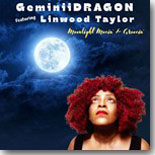 I was not
familiar at all with the New Orleans band
GeminiiDRAGON until I received a copy of
their latest release, Moonlight Movin' &
Groovin' (Nepotism Records), which I
understand is their fourth release and features
D.C. guitarist extraordinaire Linwood Taylor. I was not
familiar at all with the New Orleans band
GeminiiDRAGON until I received a copy of
their latest release, Moonlight Movin' &
Groovin' (Nepotism Records), which I
understand is their fourth release and features
D.C. guitarist extraordinaire Linwood Taylor.
Hearing it, I'm
encouraged to check out the previous three
releases because this is blues, rock, and soul
at its rawest. The album includes 11 original
songs written by GeminiiDRAGON, Christian
Simeon, and Taylor. Simeon also produced with
The HATERZ.
The opener,
“Blues Is So Good,” sets the tone for the rest
of the album, with Taylor's stinging lead guitar
and GeminiiDRAGON's sultry vocal. It's a tough
act to follow, but they're more than up to the
task with “Low Down Dirty (DUCK),” a low-down
funky blues about a lying, cheating lover about
to face the music with some nice slide guitar
mixed in.
“Pressure”
features guitarist Santiago Ortega and has a bit
more of an R&B/pop feel, but the lyrics are all
blues, dealing with the stress and strain of
trying to make a living.
The gritty blues tale “Mr. Slip & Slide Man”
tells of a modern-day back-door man, leaving
women and broken marriages in his wake, while
the energetic “Midnite Call,” which borrows and
expands upon the theme from Robert Cray's “Phone
Booth,” punches things up a bit with a standout
vocal from GeminiiDRAGON and fine fretwork from
Taylor.
“Slow Slow Moan”
is a compelling tune with lyrics that paint a
vivid image of pain, exhaustion, and
desperation, and “Rainy Wednesday,” with Ortega
again on guitar, reflects on Hump Day from a
blues perspective.
“Sideways Down”
is an upbeat tune with a driving rhythm about
someone bombarded by misery and losing ground
fast. The next two songs, the boisterous “Blues
Party” and the slower, sweatier countrified
blues “Juke Joint Jumpin',” showcase the
harmonica work of Julia Dill. The album closer,
“All Night (Bonafide Heartbreaker),” mixes blues
and funk about being unable to get rid of a man
who's bad news.
GeminiiDRAGON's
vocals seamlessly ease between the blues, soul,
R&B, and even a bit of rock on these 11 tracks,
and Taylor's guitar work is impeccable. If
you're unfamiliar with this Louisiana soul/blues
combo, I strongly recommend you give
Moonlight Movin' & Groovin' a spin. I
promise you'll want to hear more.
--- Graham Clarke
 The northern
California blues band Delta Wires
recently issued their latest release, the single
“Searching For A Woman (A Tribute To Chess
Records)” on Mudslide Records. The northern
California blues band Delta Wires
recently issued their latest release, the single
“Searching For A Woman (A Tribute To Chess
Records)” on Mudslide Records.
Ernie Pinata,
bandleader/vocalist/harmonica player, has long
been a fan of the Albert King tune and has
wanted to cover it for a long time. He also
wanted it to be a tribute to Chess due to the
label's importance to the blues genres since the
late '40s.
Pinata is backed
by Richard Healy (guitar), Tom Gerrits (bass),
Anthony Malfatti (B3), Tony Huszar (drums),
David Bowman (trombone, cimbasso, arrangements),
John Christensen (trumpet), and Caleb Murray
(tenor/baritone saxes). The band turns in a
robust, gritty version of the tune.
--- Graham Clarke
|