|
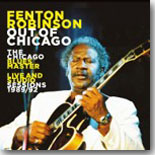
Fenton Robinson
Out of Chicago: The Chicago Blues Master – Live
and Studio Sessions 1989/92
JSP Records |
Dubbed "the mellow
blues genius" by his adoring
Japanese fans, Fenton Robinson was often
frustrated by the reception he received in the
U.S., due to his laid-back, jazzy approach to
the blues.
He enjoyed some success with Duke
Records, where he teamed with Larry Davis,
playing guitar on Davis' "Texas Flood," as well
as recorded a few sides of his own, among them
the original version of Peppermint Harris' "As
The Years Go Passing By."
He moved to Chicago in the early
'60s, where he
recorded his signature tune, "Somebody Loan Me a
Dime" for the tiny Palos label in 1967. It was
later famously recorded by Boz Scaggs,
converting it into a ballad and employing Duane Allman for a memorable guitar solo. The song was
mistakenly attributed to Scaggs and it took
many years for Robinson to reclaim composer
credits.
He also recorded a pair of forgettable
albums for a Nashville label, who took his
guitar away and put him in an ill-fitting
blues-rock mode.
By the mid-'70s, Robinson hooked up with
Alligator Records, releasing three well-received
albums, the first two being Somebody Loan Me a
Dime in 1974 and I Hear Some Blues Downstairs in
1977.
The third Alligator release, 1984's
Nightflight, was originally released on the
Dutch label Black Magic as Blues in Progress, as
was 1989's Special Road, which was reissued by
Evidence Records in the mid '90s.
Those releases pretty much made up the musical
catalog of Fenton Robinson, who passed away at
62 in November of 1997 from brain cancer.
Fortunately, the UK label JSP Records released
Out of Chicago: The Chicago Blues Master – Live
and Studio Sessions 1989/92 back in 2020.
Out of Chicago collects live songs from the 1989 Burnley Blues Festival in England, the 1992
Ecaussinnes Festival in Belgium, and four tracks
recorded at the BBC Studios a couple of days
after the Burnley Festival. All of the 1989
songs feature Robinson backed by the Norman
Beaker Band.
The BBC songs open the disc, a powerful reading
of "You Don't Know What Love Is," the slow
groover "I Had A True Love," a funky take on
Rosco Gordon's "Just A Little Bit," and the
gently swinging "You Say You're Leaving," all
tunes he previously recorded on his Alligator
releases. These tracks all have a great, crisp
sound from Beaker, and his band mates (Beaker –
guitar, Dave Bainbridge – keys, Lenni – sax,
Chip O'Connor – bass, Tim Franks – drums) are
just excellent in support on these sides and the
Burnley Festival dates.
The two songs from Burnley are the Chicago blues
standard, "Help Me,' famously recorded by Sonny
Boy Williamson II, Junior Wells and others, and
"Stormy Monday," recorded by just about
everyone. Both songs are exceedingly well done.
Again, the Norman Beaker Band is just spot on
and it's obvious that Robinson is very
comfortable playing with them, stretching both
tunes out for the band and interacting with the
enthusiastic audience.
The final four tracks, recorded in Belgium, find
Robinson backed by a great Chicago band that
includes Son Seals (guitar), Nicola Beccatoni
(rhythm guitar), Jeremiah Williams (bass), Rick
Howard – drums, Norman Grotsinger (sax), and Dan
Rabinowitz (trumpet). I'm assuming that it's
Seals' band since he introduces Robinson before
their first track, the jazz-inflected
instrumental "Nightflight."
The funky "Ghetto Train" (maybe a hybrid of
Luther Ingram's "Ghetto Train" and Donny
Hathaway's "The Ghetto") is a mostly
instrumental number that teams Robinson's guitar
with Seals' distinctive fretwork, and they sound
great together.
"Going To Chicago" is a slow
burning version of an old Count Basie number
that originally appeared on Somebody Loan Me a
Dime with more splendid guitar work and
sympathetic support from the band.
The album closes with a live reading of "You
Don't Know What Love Is," which won't bother
listeners a bit. This live version is just as
masterful as the version that opened the disc.
Sadly, Fenton Robinson didn't seem to get the
attention and acclaim he deserved while he was
still with us. All of his recordings are
uniformly fine, and the Nashville recordings
have their moments, to be fair.
Out of
Chicago: The Chicago Blues Master – Live and
Studio Sessions 1989/92 is an excellent addition
to that unfortunately slim catalog.
--- Graham Clarke